In this article, we will learn how to initialize a 2D array in Java. The elements in a 2D array are arranged in rows and columns in the form of a matrix. In this example, we have first created a 2-dimensional array of size 4x4, which means 4 rows and 4 columns. Then we have looped over it two times, first time to populate the array with integer values and the second time to go through each index and print their values. Arrays can contain any combination of Ruby data types — booleans, integers, strings, or even other collections in the form of nested arrays and hashes.
A nested, or multidimensional array, is an array whose individual elements are also arrays. You can use theArraySetfunction to populate a 1D array, or one dimension of a multidimensional array, with some initial value, such as an empty string or zero. This can be useful to create an array of a certain size, without adding data to it right away. One reason to do this is so that you can reference all the array indexes.

If you reference an array index that does not contain some value, such as an empty string, you get an error. Though it's not common to see an array of more than 3 dimensions and 2D arrays is what you will see in most of the places. It's one of the most useful data structures in the programming world. Whatever you see on your screen is nothing but a 2D array that is populated using tiles.

Be aware of the fact that, unlike languages like C or C++, Java arrays are objects and in multidimensional arrays all but the last level contain references to other Array objects. I'm not 100% sure about this, but most likely they are distributed in memory, thus you can't just fill a contiguous block without a loop, like C/C++ would allow you to do. All he wanted was some method in Java API to initialize multidimensional arrays to some default value in single step. On the front panel, hover over the bottom-left resizing node of the array indicator until the multi-dimensional array resizing node appears.
Resize array.Resizing to larger than your specified dimensions is fine. When the program is run, only the array elements within your specified row and column dimensions will be initialized. In Python to iterate a 2-dimensional array we can easily use for loop() method in it and for creating a numpy array we can apply the arange() function along with reshape.

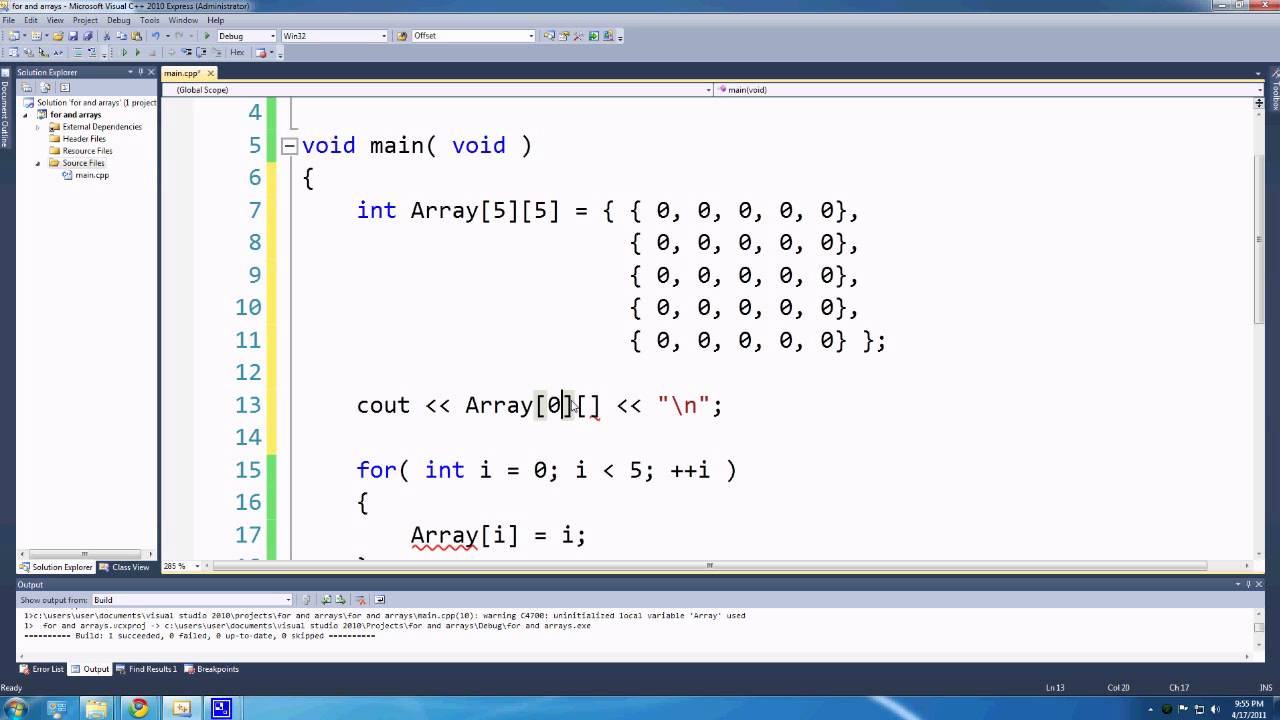
Once you will print 'i' then the output will display the 2-dimensional array. The expression above describes that we have a 2-dimensional array with 3 rows and 3 columns. In this way, we have declared and initialized a 2-dimensional array in a single line of code. The 2-dimensional array is then printed using a nested for loop, as shown below. For a two-dimensional array, in order to reference every element, we must use two nested loops. This gives us a counter variable for every column and every row in the matrix.

A two-dimensional array is a collection of a fixed number of components arranged in rows and columns , wherein all components have the same data type. In the above program, we have created two different arrays by using np.array() function and assign integer values in it. Now use concatenate() method for combining two-dimensional arrays. Sometimes we will need to store data in the form of an array. We've already seen such arrays in the tutorial on loops but as for a reminder. They start at index 0 and can contain a defined type of element.

In other words, it's like a variable containing multiple elements of a same kind. In order to make use of the 2D array, you must know how to populate and iterate over it and that's what you will learn in this article. You can think about a two-dimensional array as a matrix that has rows and columns, this helps to visualize the contents of an array. In order to loop over a 2D array, we first go through each row, and then again we go through each column in every row. Two-dimensional arrays are quite useful to store tabular data or develop 2D games, graphics, and solutions for an algorithmic problem using an adjacency matrix.

Two-dimensional arrays or objects can easily be integrated with JSX to create UI at runtime in React. This guide covers the details of various techniques to create and display data using a two-dimensional array in React. Multidimensional arrays are just arrays of arrays and fill (…) doesn't check the type of the array and the value you pass in . Thus you can't fill a multidimensional array reasonably well without using a loop.

In this type of array the position of an data element is referred by two indices instead of one. So it represents a table with rows an dcolumns of data. Such data for 4 days can be presented as a two dimensional array as below. Multidimensional arrays are just arrays of arrays and fill(…) doesn't check the type of the array and the value you pass in .

Each cell is a rectangle whose brightness oscillates from with a sine function. You will need as many for a loop as many dimensions of the array you have. For example to explicitly initialize a three-dimensional array you will need threenested for loops.

On the other hand, to initialize a 2D array, you just need two nested loops. Similarly, 3D arrays can be used to represent things in three-dimensional space using X, Y, and Z coordinates. Some of the popular examples of two-dimensional arrays are chess board, checkers board, and other board games which have slots.

You can view the chessboard as an array of 8 rows and 8 columns. In java (and C and C++) there are no multi dimensional arrays!!! Your matrix is a simple one dimensional array, where every "field" is again a one dimensinoal array. Your call to Arrays.fill() tries to place a int (to have a double write 0.0 and not simply 0) into the "matrix", which does not work.

The type declarations for symbol and state represent the command symbols and the states for the FSM. The transition matrix, next_state, is a two-dimensional array constant indexed by the state and symbol type. An element at position in this matrix indicates the next state the FSM should move to when it is in state i and the next input symbol is j.

The matrix is initialized according to the transition diagram. The process uses the current_state variable and successive input symbols as indices into the transition matrix to determine the next state. For each transition, it performs some action based on the new state. The actions are implemented within the case statement.

However, sometimes you want to store values with more than one key. Like one-dimensional arrays, two-dimensional arrays can be initialized when they are declared. The elements of each row are enclosed within braces and separated by commas and all rows are enclosed within braces. To output values from 2D and 3D arrays, employ nested loops to return array data. With a one-dimensional array, a singlecfloopis sufficient to output data, as in the previous example.
With arrays of dimension greater than one, you maintain separate loop counters for each array level. In Python to declare a new 2-dimensional array we can easily use the combination of arange and reshape() method. The reshape() method is used to shape a numpy array without updating its data and arange() function is used to create a new array. In the above program, we have initialized an empty array and then use the numpy append() function for adding items in it. Once you will print the 'out1' then the output will display the new 2-dimensional array. "Column-major order" refers to an ordering of 2D array elements where traversal occurs down each column - from the top left corner to the bottom right.

"Row-major order" refers to an ordering of 2D array elements where traversal occurs across each row - from the top left corner to the bottom right. The element type of the resulting array is automatically determined by the types of the arguments inside the braces. If all the arguments are the same type, then that is its eltype. If they all have a common promotion type then they get converted to that type using convert and that type is the array's eltype.

Otherwise, a heterogeneous array that can hold anything — a Vector — is constructed; this includes the literal [] where no arguments are given. Many functions for constructing and initializing arrays are provided. In the following list of such functions, calls with a dims...

Argument can either take a single tuple of dimension sizes or a series of dimension sizes passed as a variable number of arguments. Most of these functions also accept a first input T, which is the element type of the array. Multidimensional arrays may be initialized by specifying bracketed values for each row. Following is an array with 3 rows and each row has 4 columns.

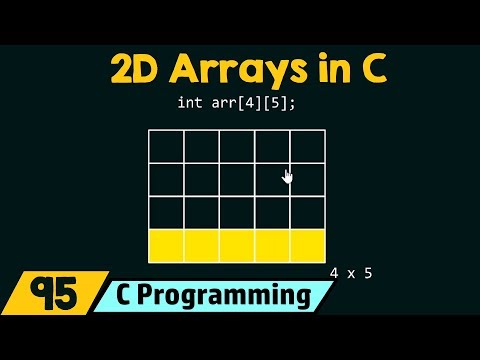
The two dimensional array in C programming is also known as matrix. A matrix can be represented as a table of rows and columns. Before we discuss more about two Dimensional array lets have a look at the following C program. As the name indicates, multi dimensional arrays are arrays that contain more than one dimension, usually two or three but it can have up to 32 dimensions. Add a constant of your desired data type to theelementinput.
This will fill in all elements throughout your array.In the example below, there are 5 rows and 2 columns defined in the 2D array. The array will be filled with string datatype elements, initialized to all say "hello." In the above program, we have used the np.zeros() function in which assigned the shape of the array elements. Now once you will print the 'arr1' then it will display a 2d array of 3 rows and 3 columns filled with zeros. In the above code first, we have imported a numpy library and then create a variable 'arr1' and assign a numpy array function for creating a 2-dimensional array.
The most common way to declare and initialize a 2-dimensional array in Java is using a shortcut syntax with an array initializer. Here using , , , we enclose each row's initialization list in its own set of braces. To iterate through each element of a 2-dimensional array, we need to use nested for loops.
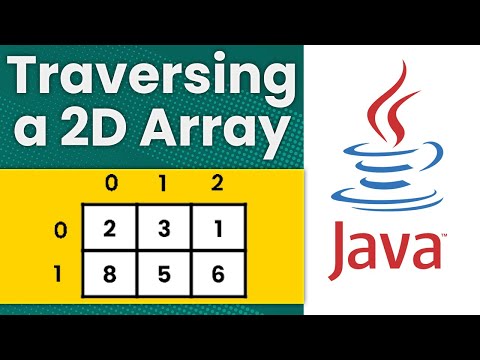
We can visualize table like 3 individual arrays of length 3. The expression table.length denotes the number of columns, which is 3 in this case. In fact, it is one of the most useful data structures in game programming. Another natural use of a multi-dimensional array is in matrix maths e.g. matrix multiplication, adding two matrices, transposing matrices, etc. It is a 2-dimensional array, that can hold a maximum of 12 elements, Remember, Java uses zero-based indexing, that is, indexing of arrays in Java starts with 0 and not 1.

Let's take another example of the multidimensional array. We can also use aggregates to write multidimensional array values. In this case, we treat the array as though it were an array of arrays, writing an array aggregate for each of the leftmost index values first.

PHP supports multidimensional arrays that are two, three, four, five, or more levels deep. However, arrays more than three levels deep are hard to manage for most people. In the above program, we have imported a numpy library and then create two different arrays by using np.array.

Now we want to append these arrays and store them into 'new_res' variable. Once you will print 'new_res' then the output will display a new numpy array. By using numpy.ravel() method we can get the output in 1-dimension array form. In Python, this method will always be returned a numpy array that has the same datatype and if the array is a masked array then it will return a masked numpy array.

In the above example, we have applied the np.arange() and reshape() method for creating a two-dimensional array. Once you will print the 'new_arr' then the output will display the 0-12 integer numbers. By using the np.arange() and reshape() method, we can perform this particular task. In Python the numpy.arange() function is based on numerical range and it is an inbuilt numpy function that always returns a ndarray object. While np.reshape() method is used to shape a numpy array without updating its data. In the above example of a two-dimensional array, defines the no of rows and columns.

The first rank denotes the no of rows, and the second rank defines no of columns. The following figure illustrates the two-dimensional array divided into rows and columns. Just like a single-dimensional array, we can also fill the multidimensional array by using the Arrays.fill() method. In order to fill a multidimensional array, we use the for loop to fill each row of the multidimensional array.

Therefore, the way 2D arrays are declared is similar 1D array objects. 2D arrays are declared by defining a data type followed by two sets of square brackets. Often referred to as logical indexing or indexing with a logical mask, indexing by a boolean array selects elements at the indices where its values are true. Indexing by a boolean vector B is effectively the same as indexing by the vector of integers that is returned by findall.